
Elden Ring
An entry by Clayton Harris.
Introduction


Elden Ring is an action role-playing game released on February 25, 2022 by developer FromSoftware and publisher Bandai Namco Entertainment. It is available on the Playstation 4, Playstation 5, Windows, Xbox One, Xbox series X/S, and soon to be released for the Nintendo Switch 2. The open world map of the Lands Between allows players to control a fully customizable character as they progress through fighting bosses on their quest to repair the Elden Ring and take their place as the newest Elden Lord.
Gameplay and Plot Overview
The opening cinematic of the game sets the scene for your journey. You are one of the Tarnished—a human who has died outside of the Lands Between, but resurrected to enact the will of an unknown greater being. You are not the first to be called, since all before you have failed, and yet you set out on this ambiguous quest without knowing quite what succeeding entails. You begin the game in a fight with a Grafted Scion in a scripted loss, before reawakening in Limgrave, the starting location in this open-world map. A golden light known as the "guidance of grace" points you in the right direction, and you meet your guide for the adventure, Melina, a woman with undetermined vitality and strength; she is a spirit, but with a higher calling that she too does not understand. With Melina at your side, it affords the ability to convert your runes into strength, a mechanic that allows you to use the in-game currency to improve your character through a skill point system. This mechanic, along with the numerous different weapons and spells that the player can find, forms the backbone of the linear power scaling within the game. By defeating the Shardbearers (main story bosses) and collecting Great Runes, you progress further in both knowledge and breadth of your quest. You learn that you have been sent by Queen Marika to repair the Elden Ring, and by collecting all of the Great Runes, you stand before the Erdtree and prepare to take your place as the Elden Lord. After defeating the Fire Giant and using his flame to set the Erdtree alight, the world of the Lands Between unexpectedly falls apart. You fight your way through a floating island—the Crumbling Farum Azula—and eventually find yourself in Leyndell, the Royal Capital to defeat the king Morgott, followed by the previous Elden Lord Godfrey. With nothing left in your way, you step into the Erdtree to fight Radagon, the current Elden Lord, and a god who lives in the body of Queen Marika. As you defeat Radagon, the god within him sheds his skin and achieves his true form, the Elden Beast. It serves as a vassal of the Greater Will, and the true form of the Elden Ring itself. As you succeed in this final battle, you transcend your Tarnished identity and take your place on the throne as the newest Elden Lord.
Autoethnographic Content
Elden Ring is the first soulslike game I had ever played, and essentially the first single-player story game I had played too. I never watched any playthroughs, or found out any spoilers, and so I went in fully blind. Safe to say that it was an exceptional experience, and remains near the top of my favourites list to this day. There were so many memorable parts from this masterpiece, but here I’ll include my personal favourite, and it might contain a small spoiler for those who haven’t played the game. After defeating Morgott the Omen King, you fight Godfrey, the first Elden Lord. In the cutscene before the fight begins, Godfrey holds Morgott’s dead body in his arms. The camera pans to a wide angle shot showing both Godfrey and your own character. During this angle, a Site of Grace appears where Morgott’s body was, next to Godfrey. The Site of Grace is the checkpoint system of Elden Ring, and they are each accompanied by a gold string of light that points in the direction of your next objective. However, before this battle, this Site of Grace belongs to Godfrey, and the golden light points towards you. In this moment, you become the boss, and by the will of the gods you are meant to die at his hands. Such a subtle plot decision, yet an incredibly powerful one that still gives me chills as I write this now.
Collapse of Self

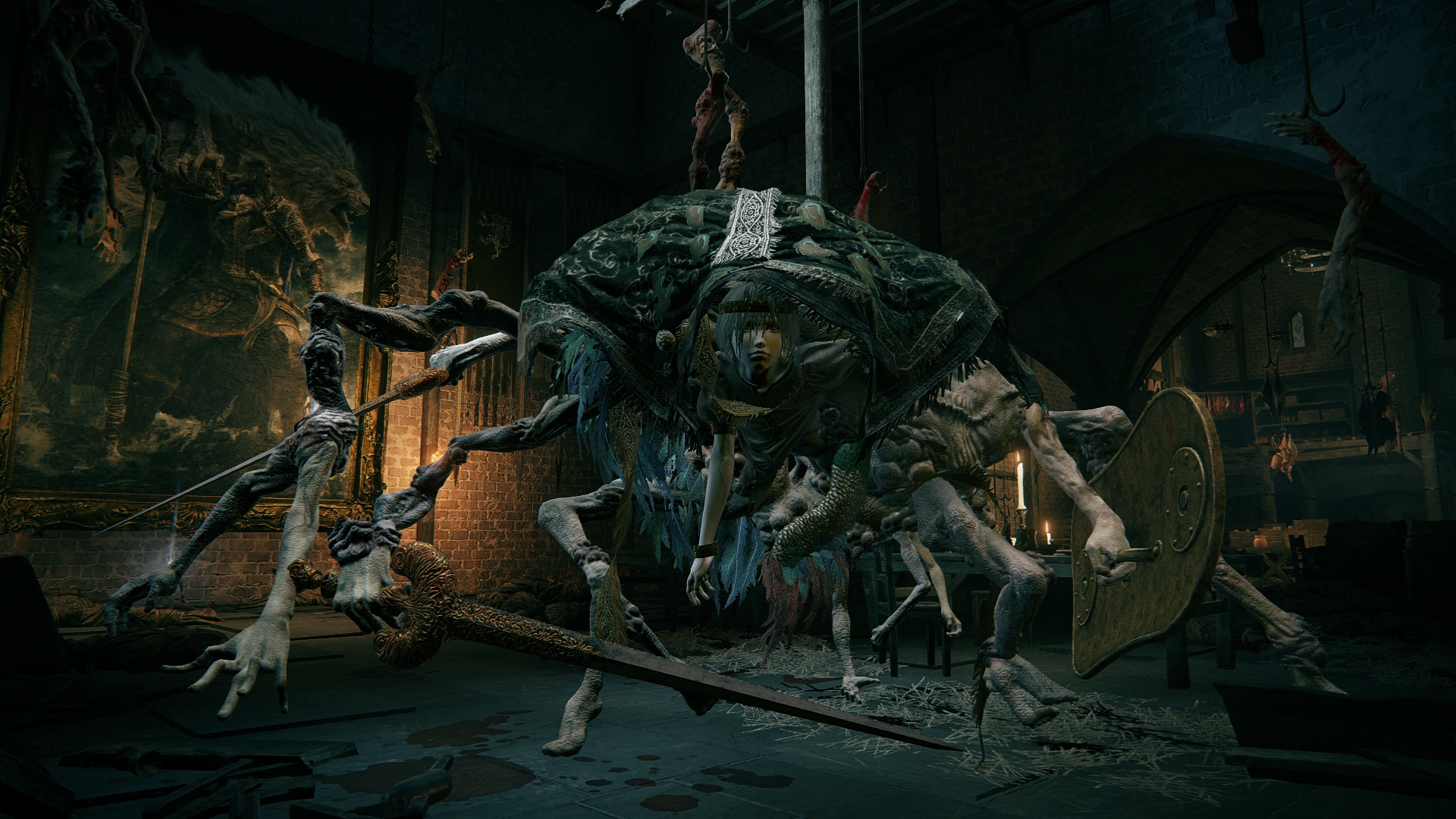
Elden Ring follows a narrative that incites rumination, and yet before we even think, we feel. It posits victory against these monsters as glorious and prideful, but with an in-game mechanic of infinite resurrection, it never lets us understand just what happens if we truly fail. We are not naive to the truth of what we can see in these bosses, nor to what we are told by those who warn us of what is to come. One of these cautioners is Roderika, a quest-giving NPC that appears in a shack directly before you enter Stormveil Castle. She speaks of those who fought for her, and of their horrible fates. All of her men were killed by the guard of the castle, the Grafted Scion. Yet what Roderika fears is not just being killed by the Scion, but instead joining it. The Grafted Scion harvests limbs and sews them to itself as a living weapon; as you go in to fight it, you can see arms and legs hanging from the ceiling in preparation to be attached. Julia Kristeva speaks on this form of horror, stating "It is thus not lack of cleanliness or health that causes abjection but what disturbs identity, system, order" (Kristeva 4). The Scion not only threatens life, but a desecration of the self and its flesh as well, inciting a fear that transcends pure survival instinct, settling more into abjection as Kristeva defines it. It leads to the harrowing understanding that the boundary between body and invader is not guaranteed. In this instance, PC Gamer points out how Roderika "admonishes herself" for not giving herself to the Scion and joining the fate of her men, showing some form of survivor's guilt (Mellor). We may be partial to believing that this monster is some sort of grotesque anomaly, considering the repulsive nature of its composition. However, in the Lands Between, the Scion is expected to exist, reflecting the horrible truth of the world. Its existence is not random, but instead allowed and even encouraged by the higher gods of the land. Jeffery Jerome Cohen argues that "the monster's body is a cultural body," and it is summoned into being not as an aberration, but as an expression of the culture that produced it (Cohen 4). It not only exists to warn, but it "signifies something other than itself," that being the evil of the world that allowed such a creature to exist and thrive.

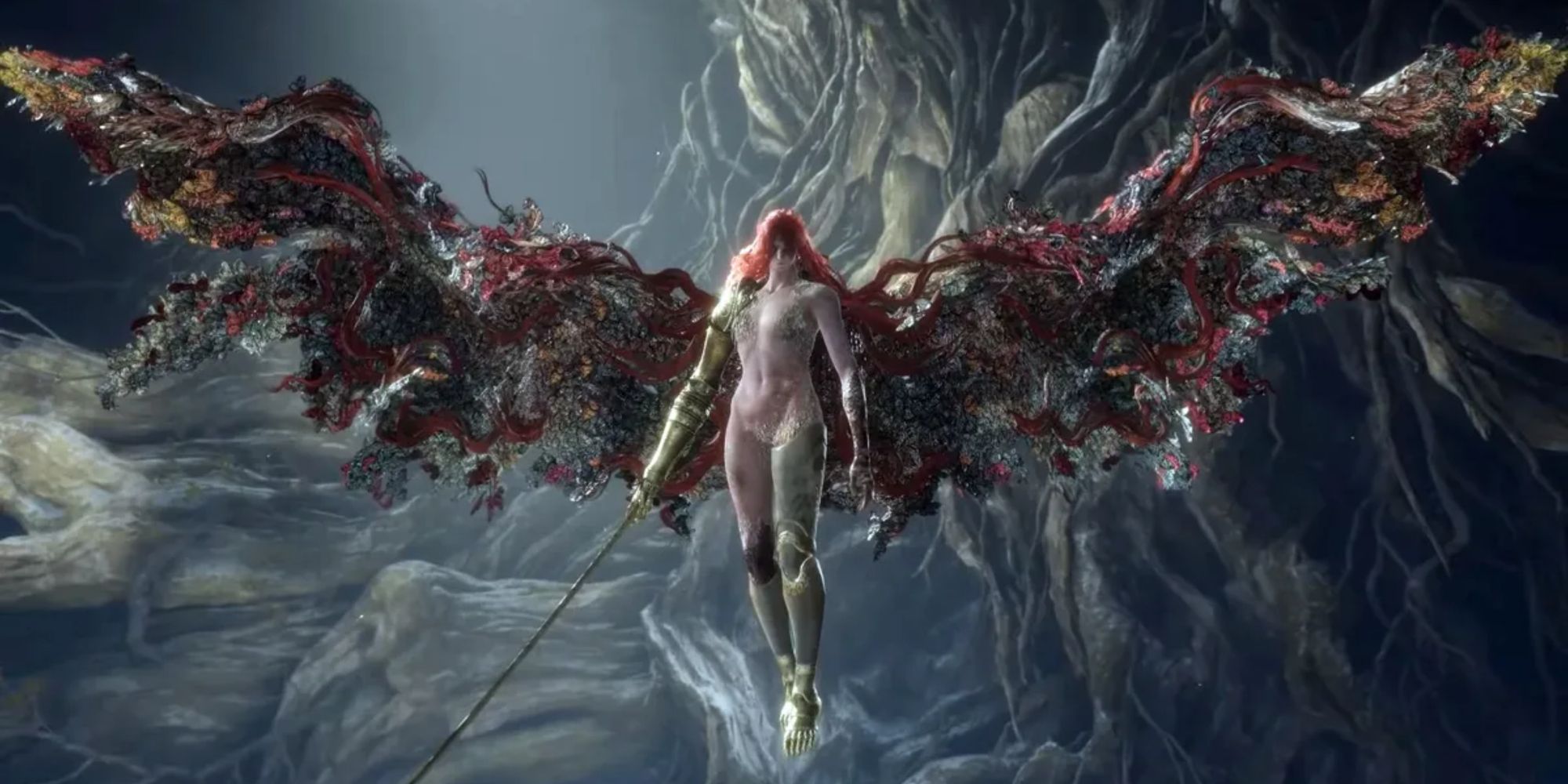
This Grafted Scion is of course not the only agent of abjection within the Lands Between. If it represents horror as grotesque assimilation, Malenia shows abjection through the worship of her decay—the collapse of beauty into rot. Kristeva states that the abject "beseeches, worries, and fascinates desire, which nevertheless does not let itself be seduced" (Kristeva 1). Malenia is a paragon of beauty and power—almost angelic, or ceremonial in the manner that she is depicted. We learn to understand that this ethereality is false, and how she truly is rot disguised as glory. The fear that she causes is not only rooted in her nature as a carrier of the Scarlet Rot, but more in that she reveals a future the Tarnished cannot fully reject. We do not fear her as an enemy, we fear her as prefiguration—an omen of our abject trajectory, and of what remains of us when we reach the end. Kristeva states that the abject dissolves the subject, "until it finds that the impossible constitutes its very being, that it is none other than abject" (Kristeva 5). The body of the player does not only witness decay, but it is forced by the world to join it. As we play, we begin to understand that we are unable to run from assimilation; we are destined to dissolve into some other, or into the rot that this land perpetuates.
Collapse of Nature


This threat of decay is not temporary; it stems from the very land that gives host to your journey. The location within Elden Ring that shows the greatest effect of Scarlet Rot is the land of Caelid. We may assume that the land is dying, but it is already dead, and yet this does not stop it from being a threat. Scarlet Rot in Elden Ring is a plague; it rips life away, decays the bodies of both the living and dead, and drives those afflicted with it to madness, behaving like beasts and causing mankind to lose its humanity. Unfortunately for those who live in the Lands Between, Scarlet Rot does not shy from rearing its ugly head at every chance. It not only diseases creatures, but the soil, the air, and the water as well. It is determined to complete two goals, over and over: expand and destroy. Despite being named by the inhabitants of the world, no one truly understands what it is, or what it can do. They can see the destruction it causes, the madness too, but they cannot define it in a way that truly explains it. Is it a disease, a climate, a creature, or some abomination of all three? Timothy Morton speaks on the concept of Hyperobjects, which refers to a phenomenon with "numerous properties," "directly responsible for... the end of the world" (Morton 1-2). These properties include viscosity, non-locality, temporal undulation, phasing, and interobjectivity—hyperobjects stick to everything that is involved with them, are present everywhere at once, are older than the gods and will outlive them, can only be seen in fragments, and entangle entire systems at once. Kathryn Hemmann speaks on how this ecological terror shows that this level of destruction caused by the Scarlet Rot cannot be healed in any way (Hemmann 6). This horror extends further however, because it also cannot be slowed, reasoned with, or escaped.

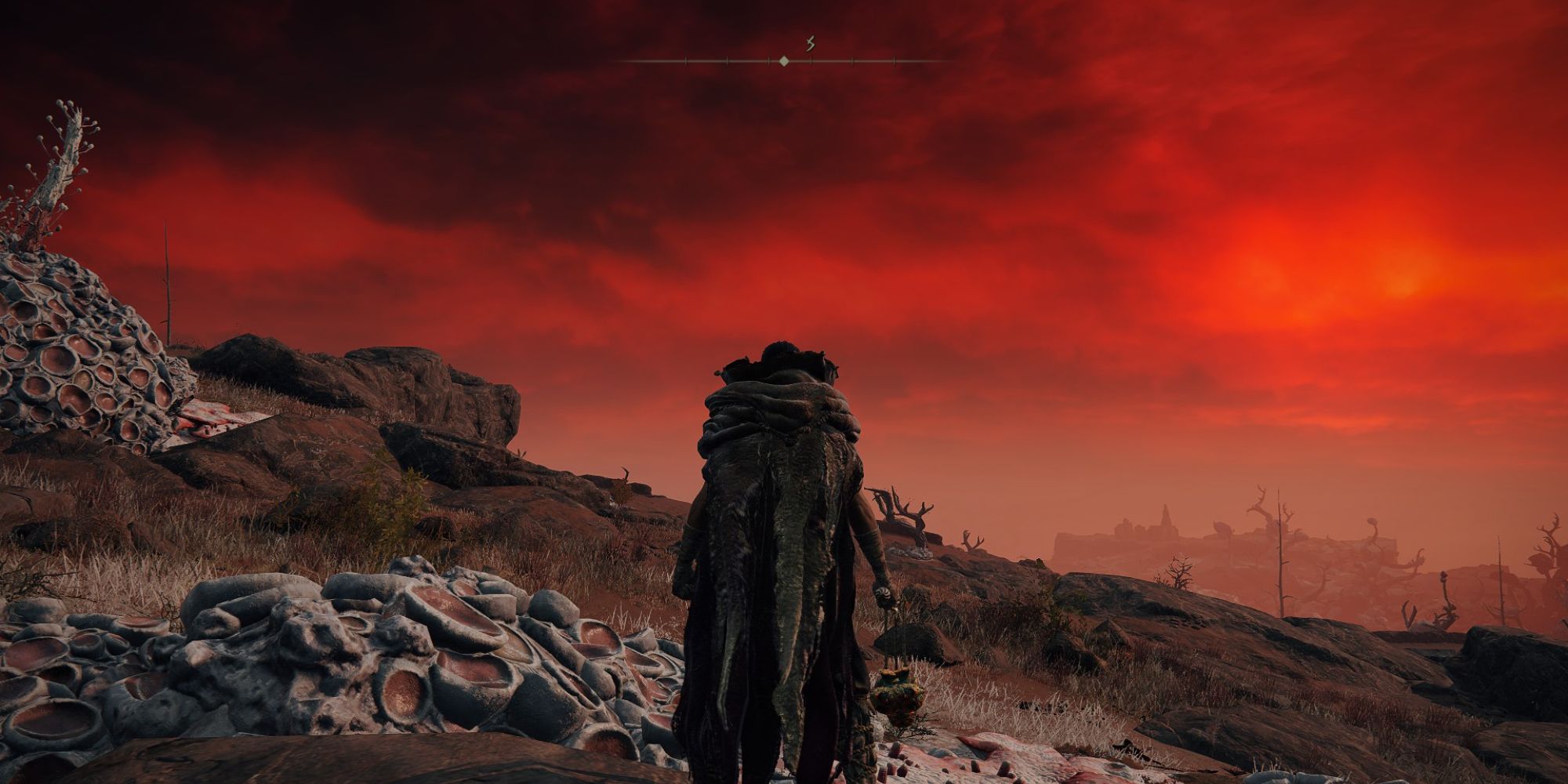
The inevitability of total ecological consumption by Scarlet Rot leads to a reluctant acceptance of the corruption. When no other choice is presented, Donna Haraway insists on "staying with the trouble," recognizing that there is no feasible return to purity, no return to the world before the corruption (Haraway 1). Elden Ring enforces a similar idea as a means of horror, by allowing the Tarnished no possible way to save the land from this rot, and no way to escape it either. We are forced to trudge through it—often literally—as we progress through the more political and spiritual nature of our main quest, shrugging off the rot as something we are forced to endure. Regardless of our success in the story, the corruption would persist indifferent to our efforts, and truly indifferent to everything else—utterly inexorable. As noted in ArtReview, the land of Caelid is a parallel to Boschian hellscapes, where bodies and environments fester together in tandem (Martin). This rot does not persist by accident, but instead it is allowed by the same divine entity that we call to for guidance. It is not the result of an absence of higher power, but instead a display of divinity that has become complicit with abhorrent truths.
Collapse of Providence

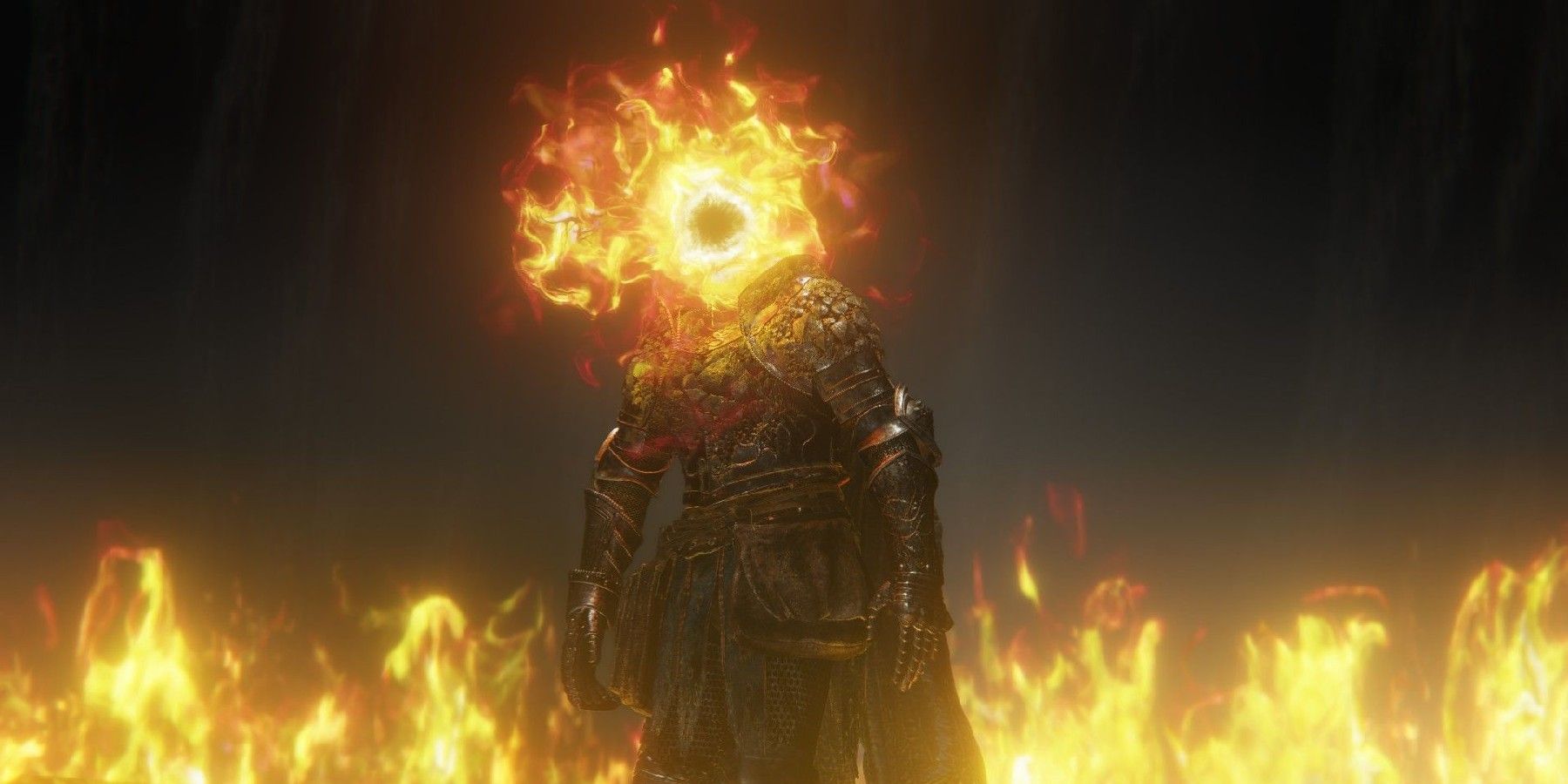
But is this complicity, or is it intentional? Is it that some higher power allows this to happen, or does the divine incite this repugnance? We come to learn of something known as the Frenzied Flame as we progress through the story. This entity promises liberation through dissolution of everything—every thing. The success of the Frenzied Flame would be the removal of suffering, by means of destroying every thing that is able to suffer. Eugene Thacker speaks on the three worlds: world-for-us, world-in-itself, and the world-without-us (Thacker 9). Elden Ring exists currently as the world-in-itself, a world indifferent to humans and thus horrifying to exist in as the Tarnished. What the Frenzied Flame calls into ideation is the world-without-us, where humanity and coherence fails to hold the reins in the way it once did. NPCs within the game who are afflicted with madness—the status effect invoked by the Frenzied Flame—yearn for when everything will become one. One of the endings that the player can achieve in the game allows them to become the Lord of the Frenzied Flame, by forgoing every moral force presented in the story and choosing madness over order. To reach this ending, the player has Melina turn against them and threaten their life. As the devoted guide to the player, she has a strong sense of morality that most players should agree with. The Tarnished stands as an agent of transition for the aptly named Lands Between, where we alone choose to lean to grace, or instead to madness.


Yet with our agency in this transition, we still feel uneasy. Mark Fisher argues that horror often emerges from the eerie—the sense of intelligent intervention where none should be, or conversely the absence of guidance when we most expect it (Fisher 39). Elden Ring shows this as the Greater Will, the opposing force to the Frenzied Flame. In contrast to the incineration of meaning we spoke on earlier, the Greater Will enforces meaning at any cost and without mercy. It is not absent, but ever-present and surveilling. The player has a constant sense of something inscrutable, but something with direct intention and a striking hand. Even at the basis of our story, we are guided by the Greater Will by means of the Sites of Grace—the checkpoint system within the game. We would like to assume that the Greater Will is objectively good, since it opposes the Frenzied Flame and all it represents, but we cannot be so sure. In opposition to chaos is order, but the way in which this order is defended can vary. The Greater Will is silent, but it raised Queen Marika to godhood, created the Erdtree, created the Elden Beast, and called our journey into existence. Faced with this decision, we realize that neither path is just, and yet we are forced to pick one. In the story, regardless of the ending that the player chooses, we burn the Erdtree and set the world into chaos. VICE provides insight into earlier FromSoft games, speaking about a fear of divine punishment that is lost in Elden Ring (Weise). Fearing the punishment of a god assumes that there is no greater worry, but Elden Ring confronts something unimaginable—the fear of a god's indifference. The Greater Will doesn't care about you unless you are a devoted and unfailing agent of its ultimate goal, else it leaves you to rot, like nearly everything else in the Lands Between.
Gameplay Video
Since Elden Ring is a complex story game, an actual complete playthrough would be comically long. The playthrough linked below covers only the necessary segments of the game required to complete the main story.
https://youtu.be/pSY74-B7M2c?si=ulCW-NXcT1niveG9
AI Disclosure
I did not use generative AI for any aspect of planning, organizing, or writing this assignment.
Citations
Cohen, Jeffrey Jerome. Monster Theory: Reading Culture. University of Minnesota Press, 1996.
Fisher, Mark. The Weird and the Eerie. Watkins Media Limited, 2016.
Haraway, Donna J. Staying with the Trouble: Making Kin in the Chthulucene. Duke University Press, 2016.
Hemmann, Kathryn. “The Environmental Horror of Elden Ring.” Unwinnable, 2023, pp. 61-66.
Kristeva, Julia. Powers of Horror: An Essay on Abjection. Translated by Leon Samuel Roudiez, Columbia University Press, 2024.
Martin, Damian. “The Boschian Horror of 'Elden Ring.'” ArtReview, 18 March 2022, https://artreview.com/the-boschian-horror-of-elden-ring
Mellor, Imogen. “Elden Ring's horror is better because it's not dark and gloomy.” PC Gamer, 8 July 2022, https://www.pcgamer.com/elden-rings-horror-is-better-because-its-not-dark-and-gloomy/
Morton, Timothy. Hyperobjects: Philosophy and Ecology After the End of the World. University of Minnesota Press, 2013.
Weise, Matthew. “The Horror That FromSoftware Lost Between 'Demon's Souls' and 'Elden Ring.'” VICE, 12 December 2022, https://www.vice.com/en/article/the-horror-that-fromsoftware-lost-between-demons-souls-and-elden-ring/